“Foreign Tongues” — the 25th British and 27th American studio album by The Rolling Stones, released on July 10, 2026, on Polydor Records. The record serves as a continuation of Hackney Diamonds (2023) and features 14 tracks, with a total duration of around 62 minutes. Andrew Watt, who worked with the band on their previous album, returned as producer.
Interestingly, the Stones themselves perceived the material partly as a continuation of the Hackney Diamonds sessions. According to Keith Richards, so much material was created during previous sessions that some of the songs were essentially waiting for their time on the next record.
Album Creation
Unlike the long wait between Blue & Lonesome (2016) and Hackney Diamonds (2023), this time The Rolling Stones worked much faster. The main recording for Foreign Tongues was completed in less than a month at Metropolis Studios in West London. Mick Jagger, Keith Richards, Ronnie Wood, and producer Andrew Watt all returned to work on the project.
Longtime band collaborators — Darryl Jones, Matt Clifford, and Steve Jordan — also participated in the recording.
Particularly significant is that “Hit Me In The Head” features a drum track by Charlie Watts, recorded during one of his final sessions before his death in 2021. Thus, the track became another musical bridge between the classic Stones and the band’s modern lineup.
Guests
“Foreign Tongues” features a rather impressive lineup of guest musicians:
- Paul McCartney;
- Steve Winwood;
- Robert Smith of The Cure;
- Chad Smith of Red Hot Chili Peppers;
- Charlie Watts.
Paul McCartney’s participation was especially symbolic. Jagger recalled being surprised by how easily McCartney fit into the heavier, almost punk-rock material.
Main Tracks
- “Rough and Twisted” : Opens the album on a maximally bluesy and aggressive note. The song was initially released in an extremely limited quantity on white vinyl under the pseudonym The Cockroaches — only for select stores. Later, it was officially released as a Rolling Stones track. It is one of the most “old-school” tracks on the album by spirit: a dirty blues riff, a groove, and Jagger’s characteristic vocal delivery. This track demonstrates that the band has no intention of abandoning its fundamental blues foundation.
- “In The Stars” : The album’s first official single, released on May 5, 2026. It is a lighter and catchy track that combines classic Stones rock with a more modern production. The song well demonstrates the main principle of “Foreign Tongues”: not copying the 1970s sound, but using it as a foundation for a modern record.
- “Jealous Lover” : One of the most soulful tracks on the record and one of the main singles. Here, the band moves away from raw blues rock toward a more melodic roots rock / soul-inflected rock. It is precisely these kinds of compositions that help the album avoid turning into an endless sequence of rock-and-roll riffs.
- “Divine Intervention” : One of the most interesting tracks lyrically. Jagger uses irony regarding apocalyptic moods and modern instability, turning the topic of the end of the world into a signature Stones boogie. Rolling Stone noted the spirit of ” Some Girls ” in it — lightness, humor, and at the same time a fairly dark view of the surrounding world.
- “Ringing Hollow” : A slower and more atmospheric track that expands the bluesy side of the album. Ronnie Wood’s guitar work paired with the rhythm section shines particularly well here.
- “Never Wanna Lose You” : A more melodic track about the fear of losing a loved one. It shows a more romantic side of Jagger, which occasionally appeared on late Stones albums.
- “Hit Me In The Head” : One of the heaviest and shortest tracks on the record. Its main historical feature is the participation of Charlie Watts. Watts’ contribution gives the song a special feel: it is not just a modern studio track by the Stones, but literally a recording that connects two eras of the band’s history.
- “You Know I’m No Good” : The Rolling Stones deliver their own interpretation of the Amy Winehouse track. This is one of the most unexpected moments on the album. Instead of simply copying the original, the band translates the song into their own blues-rock language, highlighting the kinship between Winehouse and the Stones through blues, soul, and the British rock tradition.
- “Side Effects” : A Keith Richards song that begins with a rather unusual idea for him. Richards paid attention to American prescription drug ads, where a long list of side effects must be read. That phrase became the starting point for the track. It is classic Richards: a simple, slightly sarcastic idea turned into a blues song with a very characteristic Stones groove.
- “Back In Your Life” : One of the longest tracks on the album — over six minutes. It is a slower track about a brief romance and the sudden disappearance of a loved one. Ronnie Wood shared that during recording he got so carried away with the guitar solo that it initially lasted about nine minutes. Andrew Watt was so impressed by the performance that, according to Wood, he even broke down in tears, though the solo had to be edited down for the album.
- “Beautiful Delilah” : The closing track — a cover of Chuck Berry, one of the most important musical heroes of The Rolling Stones. Ending the album with this song creates a full-circle moment: the Stones return to the American rock and roll from which their own music largely grew.
What Foreign Tongues Is About
Despite the traditional Stones sound, the album’s lyrics are quite modern.
Jagger and Richards address:
- political and social instability;
- fear of the future;
- tech billionaires;
- prescription drug addiction;
- love and jealousy;
- aging;
- loneliness;
- fleeting romances;
- musical heroes of the past.
Ronnie Wood noted that the band did not want to ignore what is happening in the world. Therefore, behind the usual rock-and-roll swagger of the album lies a fairly anxious view of modernity.
Cover Art
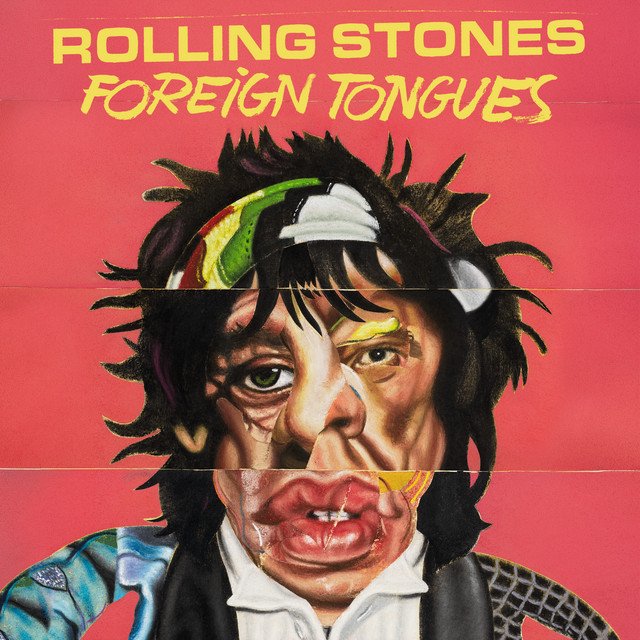
The cover art was created by Chicago-based artist Nathaniel Mary Quinn. It presents a grotesque, fragmented portrait of Mick Jagger, Keith Richards, and Ronnie Wood.
Particularly interesting is that critics saw in it a connection to the vibrant glam-trash aesthetic of The Rolling Stones in the late 1970s. Pitchfork even called it the Stones’ best cover since Some Girls. ( Pitchfork )
The cover also carries a kind of self-irony: the distorted faces of the musicians seem to turn traditional jokes about their age into part of the band’s own visual identity.
Critical and Audience Reception
The overall response to “Foreign Tongues” is positive.
AllMusic characterizes the album as an energetic, entertaining, and confident record, emphasizing that even after the death of Charlie Watts and despite the age of Jagger and Richards, the band is still capable of creating compelling rock and roll. ( AllMusic )
Rolling Stone particularly highlights that the album sounds more guitar-heavy and “Stones-like” than Hackney Diamonds. According to the publication, the band managed to continue its late-career creative surge. ( Rolling Stone Canada )
Pitchfork also finds many positives in the record, though it does not consider it flawless. The outlet points to a funkier and more robust rhythm section and notes that the Stones used the leftover material from previous sessions quite effectively. ( Pitchfork )
Listeners particularly enjoy the energy, blues foundation, guitar work of Ronnie Wood and Keith Richards, Jagger’s vocals, and the overall sense of genuine rock-and-roll vitality.
At the same time, part of the audience might find the record a bit too familiar. The Stones consciously do not attempt to radically overhaul their formula, so listeners expecting experimentation might view some tracks as simply another variation of a well-known style.
General Summary
“Foreign Tongues” is primarily an album showing that The Rolling Stones remain The Rolling Stones.
Following the success of Hackney Diamonds, the band chose not to repeat it literally. Instead, they dived even deeper into their own roots: blues, rock & roll, country, soul, and rhythm and blues. At the same time, the lyrics remain oriented toward the present day, while Andrew Watt’s production brings enough energy to the old formula.
The combination of experience and freshness is particularly valuable. The inclusion of Charlie Watts on “Hit Me In The Head”, along with Paul McCartney, Steve Winwood, and Robert Smith, turns the album into a unique gathering of several generations of British rock.
At the same time, “Foreign Tongues” should not be viewed as an attempt to surpass Let It Bleed, Exile on Main St., or Some Girls. Its success lies elsewhere: in 2026, The Rolling Stones can still record an album that sounds natural, energetic, and free of any sense of museum-like reconstruction of their own past.
Who might like it: fans of The Rolling Stones, The Beatles, Faces, Chuck Berry, Eric Clapton, The Black Crowes, and classic blues-based rock. It is especially worth checking out for those who enjoy a live guitar sound, blues riffs, a rock & roll groove, charismatic vocals, and music that relies more on atmosphere and performance than complex studio experiments.












![ONE OK ROCK – C.U.R.I.O.S.I.T.Y. [DETOX JAPAN TOUR 2025 AT NISSAN STADIUM]](https://asauldm.com/wp-content/uploads/2026/08/one-ok-rock-c-u-r-i-o-s-i-t-y-detox-japan-tour-2025-at-nissan-stadium-150x150.jpg)