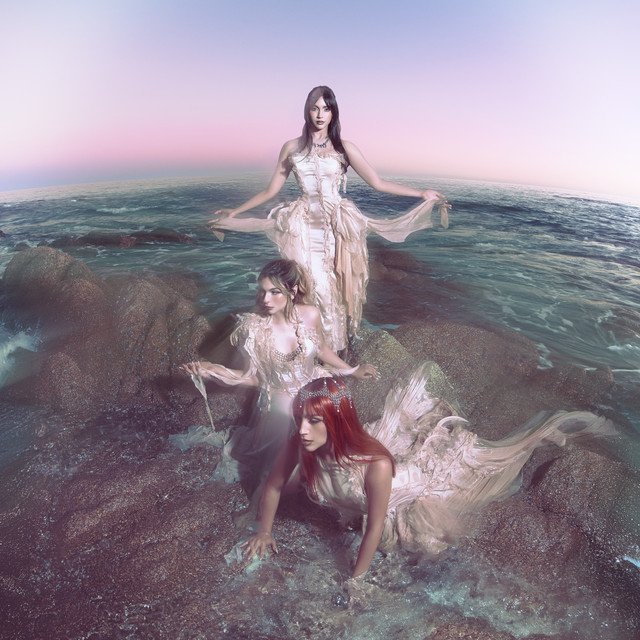
“Everything’s Falling” is the fifth studio album by Mexican rock trio The Warning, released on August 28, 2026, via Republic Records / Lava Records. The album contains 12 tracks and has a running time of approximately 39 minutes.
The record continues the direction the band developed on “ERROR” (2022) and “Keep Me Fed” (2024), but makes it darker, heavier, and somewhat more diverse. The Warning do not attempt to radically change their formula: the foundation remains a powerful bass line, guitar, live drums, and the highly expressive vocals of Daniela Villarreal, while elements of grunge, alternative metal, pop rock, and modern production are added to the mix.
What the Album Is About
The central theme of “Everything’s Falling” is a feeling of instability and the fear that everything could fall apart.
The band addresses uncertainty, self-doubt, loss of control, toxic relationships, self-esteem issues, and the need to overcome failure. At the same time, this is not a depressive album: The Warning transform anxiety into energy, aggression, and confidence. Critics identify this contrast — dark themes against energetic music — as one of the record’s main strengths.
The title “Everything’s Falling” therefore feels not simply like a description of a catastrophe, but as a moment when old ideas about oneself are falling apart, creating an opportunity to become stronger.
How the Album Was Created
The Warning worked with producer and co-writer Anton DeLost on the album. According to Apple Music, this collaboration helped the band make “Everything’s Falling” one of the most eclectic releases in their discography.
At the same time, the musical core remains unchanged:
- Daniela Villarreal — guitar, lead vocals;
- Paulina Villarreal — drums, vocals;
- Alejandra Villarreal — bass, vocals.
One of The Warning’s defining characteristics is that the sisters have been playing together since childhood, resulting in a very strong instrumental chemistry between them. On “Everything’s Falling“, this is particularly noticeable in the rhythm section: Alejandra’s bass often effectively becomes a second lead instrument, while Pau’s drumming gives the songs a highly dynamic character.
This can be heard particularly clearly in “Why Do You Like It When I Cry?” and “Bloodsport”, where the bass line is one of the main driving forces of the compositions.
Tracks Overview
“Ritual”
The album’s opening track immediately establishes its dark tone. “Ritual” is about the fear of losing something good. Even when life is going well, anxiety can convince a person that disaster is already approaching. Musically, it is one of the heaviest tracks on the record: a powerful riff, massive drums, aggressive transitions, and a highly melodic chorus. The contrast between the anxious lyrics and the almost anthemic musical structure works perfectly as an introduction to the album.
“Perfect Daughter”
One of the most personal compositions. The song explores expectations imposed on a person and the feeling that you have to conform to a particular image of a “perfect daughter”. The opening line — asking whether the protagonist was liked more at 16 — immediately introduces the themes of growing up and changing one’s identity. Musically, the composition is somewhat slower, but retains its tension and heaviness.
“Everything’s Falling”
The title track is one of the album’s most melodic and emotional moments. Unlike the aggressive “Ritual”, the band gradually builds tension here before exploding into a huge chorus. The song essentially concentrates the album’s central idea: the feeling that everything around you is falling apart, yet you keep moving forward. Buzz Magazine particularly highlights the title track, noting Daniela’s more restrained vocals and a noticeable Evanescence influence. (Buzz Magazine)
“Why Do You Like It When I Cry?”
One of the best examples of The Warning’s signature style.
It features:
- a powerful riff;
- groove;
- prominent bass;
- layered vocals;
- an aggressive chorus;
- a touch of funk/swagger in the rhythm.
The song explores a toxic dynamic in which another person seems to take pleasure in your weakness or pain. The Soundboard calls it one of the album’s strongest tracks, while the reviewer at Rock The Joint Magazine considers it a personal favorite. (The Soundboard) (Rock The Joint Magazine)
“Bite My Tongue”
A more aggressive track with a noticeable alternative metal influence. The title literally means “to bite one’s tongue” — to hold back words, emotions, or reactions. Unlike some of the record’s more straightforward rock songs, this composition features more rhythmic changes and heavier guitar passages.
“Kill Or Be Killed”
One of the heaviest tracks on “Everything’s Falling“. The composition is built around the idea of survival, confrontation, and the need to defend yourself. This is one of the moments when The Warning come closest to alternative metal, although the band’s melodic character remains intact.
“Ego”
Perhaps the most unusual track on the album. First, it is performed entirely in Spanish — the native language of the Villarreal sisters. Second, the band adds a more unconventional rhythm and a distinctive dance influence to their heavy rock sound. Apple Music describes “Ego” as an example of how The Warning experiment with guitar skronk and Spanish-language vocals, creating a groove that is somewhat unusual for them. It is also an important cultural moment: after achieving global success, The Warning do not abandon their Mexican roots in pursuit of an English-speaking international audience.
“Bloodsport”
One of the compositions where Alejandra Villarreal stands out particularly strongly. The bass effectively drives the song forward, creating a dense groove. The title — “bloodsport” — matches the atmosphere of confrontation and aggression. At the same time, the composition is not simply a heavy rock track: it contains a certain playfulness and even sinister humor, giving it additional character.
“Break”
One of the album’s more unconventional moments. Here The Warning move away from their usual powerful electric-rock sound and introduce grunge and acoustic textures. These moments demonstrate that the band is gradually moving beyond the simple formula of “guitar + bass + drums + big chorus”.
“Bruises”
A bass-driven rock track with a noticeable Royal Blood influence. The song continues the theme of psychological and emotional wounds, but musically remains highly energetic.
“Waste Your Time On Me”
One of the album’s most catchy tracks. Here The Warning combine hard rock with a more contemporary rhythmic approach. The opening, featuring programmed percussion, differs somewhat from the band’s traditional sound, before the composition moves into highly energetic rock. Listeners particularly highlight its live potential and its ability to make people sing along.
“Kerosene”
The final track is one of the album’s most playful and cheeky songs. The Warning described it as roughly what they would have written if they were a pop band that occasionally played rock. The result is a highly catchy composition with a strong spirit of 1990s alternative rock. Apple Music compares it to L7 and The Breeders, while other reviewers note its connection to female-fronted alternative rock of the 1990s. It is an effective finale: after the album’s darker themes, “Kerosene” essentially says — you can stop overanalyzing everything and simply enjoy the music.
Sound
“Everything’s Falling” sits roughly between “ERROR” and “Keep Me Fed“, but it is not simply the sum of those two albums.
Riff Magazine describes it as a combination of the dynamism of ERROR and the swagger of Keep Me Fed, but with a more mature and adventurous approach. (riffmagazine.com)
The album’s sound incorporates:
- Hard Rock — the foundation of the album;
- Alternative Rock — particularly in the melodic compositions;
- Alternative Metal — in the heavier riffs;
- Grunge — in “Break” and certain vocal moments;
- Pop Rock — in the catchiest choruses;
- modern studio production.
At the same time, The Warning do not attempt to recreate classic 1970s rock. Instead, they take the traditional power-trio formula and modernize it through production, rhythm, and song structure.
Critical and Listener Reception
The first professional reviews of the album have been predominantly very positive.
Riff Magazine — 9/10. The reviewer particularly praises the combination of powerful riffs, drive, and drama, considering the album evidence that The Warning are becoming increasingly mature songwriters. (riffmagazine.com)
Distorted Sound Magazine notes that the band does not attempt to reinvent itself, but demonstrates just how much it has grown over five albums. Its main strength is described as the ability to transform themes of anxiety and failure into energy and forward momentum. (Distorted Sound Magazine)
The Soundboard considers the record a successful balance between accessibility and The Warning’s desire to push beyond conventional hard rock. At the same time, the reviewer notes that the band has not yet achieved such a radical creative breakthrough as to make them undisputed “titans” of the genre. (The Soundboard)
Buzz Magazine is more restrained: the album is described as strong and highly infectious, but the review notes that it does not open up fundamentally new territory. At the same time, the material becomes increasingly convincing after several listens. (Buzz Magazine)
Listener reactions particularly highlight “Ritual”, “Why Do You Like It When I Cry?”, “Ego”, “Waste Your Time On Me”, and “Kerosene”. The fact that The Warning continue to expand their sound without losing their identity has also been positively received. (lpsandlibraries.com)
What Was Well Received
- powerful rhythm section;
- Alejandra’s highly prominent bass;
- Daniela’s emotional vocals;
- Pau’s strong drumming;
- catchy choruses;
- darker atmosphere;
- “Ego” as an experiment with Spanish-language material;
- grunge and alternative-rock influences;
- a short, tightly focused running time — approximately 39 minutes.
What Some Listeners May Not Like
The main criticism noted by reviewers is the lack of a radical creative breakthrough.
If a listener expects The Warning to make an album that completely transforms their style, “Everything’s Falling” may feel too familiar.
Some compositions also rely quite heavily on the modern “riff + groove + big chorus” formula, meaning that not every track is equally memorable.
Overall Summary
“Everything’s Falling” is not a revolution in The Warning’s music, but rather a very confident strengthening of their position in modern rock.
The band retains its greatest strength — the chemistry between three sisters who have played together for most of their lives — while gradually expanding their musical palette. There is heavy alternative metal, groove, grunge, pop rock, the Spanish-language “Ego”, and the almost dance-rock finale “Kerosene”.
Most interestingly, the album’s theme of falling does not correspond to its musical mood. The lyrics deal with fear, uncertainty, toxic relationships, pain, and the possibility of failure, while the music constantly moves forward. That is why “Everything’s Falling” sounds not like an album about defeat, but as an album about surviving the moment when everything around you begins to fall apart.
Who might enjoy it: fans of The Pretty Reckless, Royal Blood, Halestorm, Foo Fighters, Evanescence, Paramore, L7, and modern hard/alternative rock. It is particularly worth exploring for listeners who enjoy powerful power trios, prominent bass, big choruses, modern production, and rock that can be heavy, melodic, and radio-friendly at the same time.








![ONE OK ROCK – C.U.R.I.O.S.I.T.Y. [DETOX JAPAN TOUR 2025 AT NISSAN STADIUM]](https://asauldm.com/wp-content/uploads/2026/08/one-ok-rock-c-u-r-i-o-s-i-t-y-detox-japan-tour-2025-at-nissan-stadium-150x150.jpg)